Sunday, October 12, 2014

Mémorial Leclerc-Musée Jean Moulin

This weekend, we are visiting the Mémorial du Maréchal Leclerc de Hauteclocque et de la Libération de Paris/Musée Jean Moulin as part of our larger investigation of French and American experiences and memories of twentieth-century war.  The museums feature Général Philippe Leclerc, head of the Second Armored Division that played a major role in liberating Paris in August 1944, and Jean Moulin, leader of the French resistance and victim of Gestapo murder in 1943.  There are numerous memorials to both Leclerc and Moulin throughout France.  In Paris, Avenue du Général Leclerc serves as a major artery in the city's south; Avenue Jean Moulin and Collège Jean Moulin on Rue Alésia can be found in the 14th arrondissement.


The Mémorial Leclerc-Musée Jean Moulin is located atop the Gare Montparnasse, where Leclerc and Henri Rol-Tanguy of the French Forces of the Interior accepted German commander Dietrich von Choltitz's surrender on August 25, 1944.


Jean Moulin at left; the liberation of Paris in the center; Général Leclerc at right.

Friday, October 10, 2014

Vel d'Hiv' et le Mémorial de la Shoah

The Mur des Justes, Wall of the Righteous,
listing names of those who in France who risked
their lives to save Jews
This week, as part of our study of World War II and the French collaborationist regime, Vichy, we examined the French role in the Shoah (Holocaust).  We visited the Mémorial de la Shoah in the Marais, just blocks from the Rue des Rosiers, the traditional heart of Parisian Jewish life.  The museum contains the "fichier juif," the card catalog maintained by the Vichy government that listed the names and addresses of Jewish residents of Paris, enabling the French police to round up over 13,000 Jews in July 1942 – almost one-third of them children – and imprison them in the Vel d'Hiv', a bicycle velodrome next to the Eiffel Tower.  From there, they were sent via the Drancy concentration camp to the gas chambers.  Of the 75,000 French Jews deported during the war, only 2500 survived.


This plaque, a version of which appears outside many French schools, commemorates the deportation of Jewish children, including children from this middle school.  The Collège François Couperin is located at 2 allée des Justes, just across the street from
                                                  the Mémorial de la Shoah.

The memorials to the Vel d'Hiv' are located immediately next to the Métro station Bir-Hakeim that most tourists use to visit the Eiffel Tower.


Thursday, October 9, 2014

Cours de cuisine

Yesterday, Claudia Fontu, one of the French professors, took the F&M in Paris students to Tours de Cuisine, an atelier for learning French and cooking.  As you can see, a delicious dinner of croissants feuilletés au pesto de roquette et saumon fumé, gougères provençales, tapenade aux deux olives, tarte à la courgette gratinée au comté, tartelettes au citron meringuées, and mousse au chocolat et au caramel was prepared and enjoyed by all!


                  As the French say, "Miam, miam."

         What a great way to learn French vocabulary

                       and about French culture!


Octobre Rose

Earlier this week, the Eiffel Tower was illuminated in pink in honor of the "Octobre Rose" campaign against breast cancer led by the Ruban Rose association.


Le Métro

One of the constants of Parisian life is riding the Métro, which first opened in 1900 and serves 1.4 billion (!) passengers every year.  Le Métro provides wonderful insights into Parisian life.  Not surprisingly, its use can bring adventures, ones that affect us directly since, with the exception of one student who lives near the Accent Paris center, we all take the Métro to class.  As a result, when the Métro experiences delays, we experience delays.  We have learned to check its site for "perturbations," as the RATP (Régie Autonome des Transports Parisiens) provides – "en temps réel" – information on delays due to mechanical breakdowns, passenger injury, suspicious packages, and strikes.


Tuesday, October 7, 2014

Rouen & Giverny 2.0

           Headed toward Rouen, we drove past the Arc de Triomphe as the sun was rising!


The weather was perfect for a great group photo in front of Rouen Cathedral.  Rouen's architecture was amazing.  This Viking city was well worth the visit.


Joan of Arc was executed here in 1431.

 
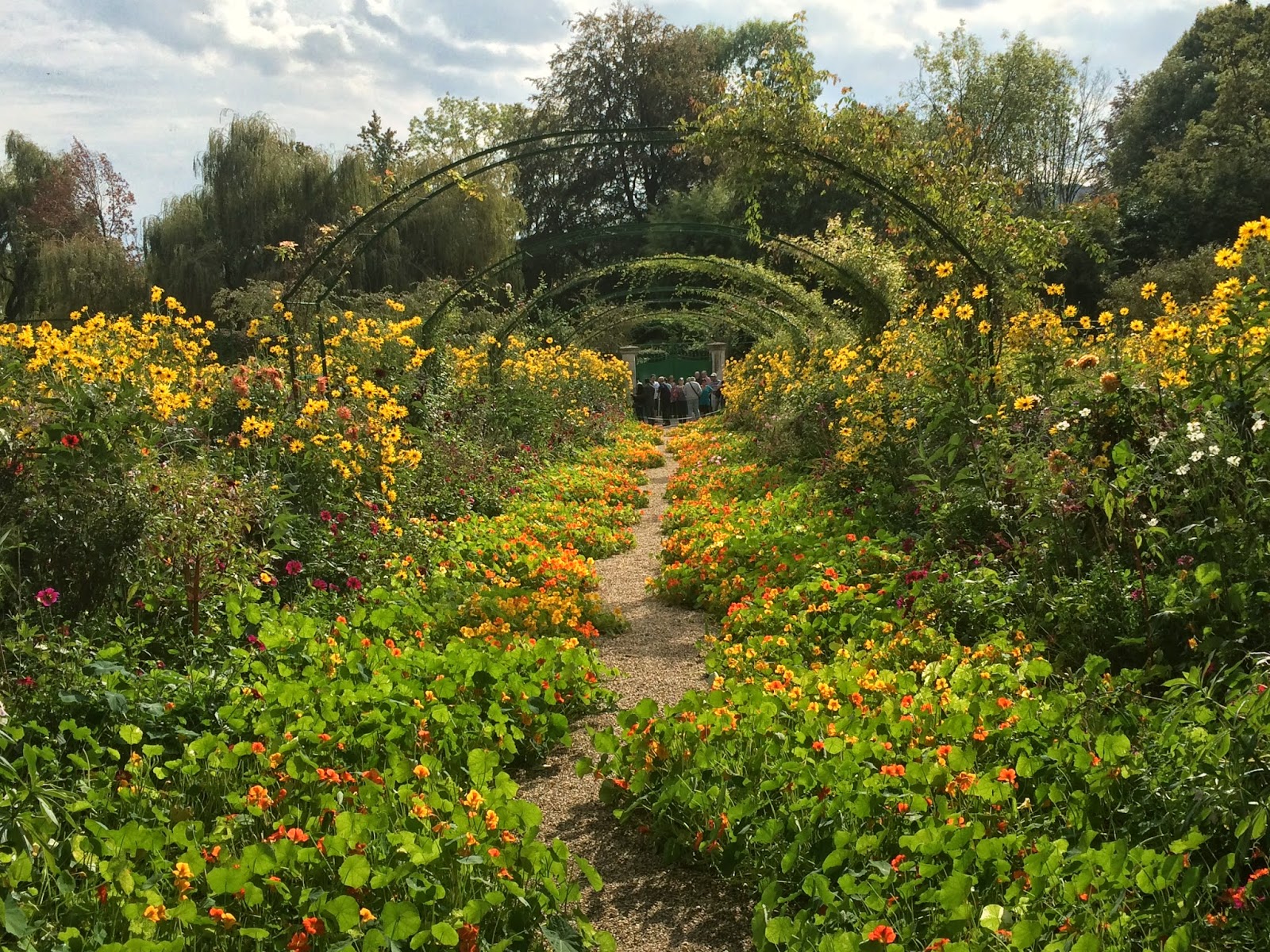
Enjoying the Gardens of Monet!


Rouen & Giverny

Thanks to Accent Paris, which facilitates our study abroad program, I went to Rouen and Giverny with my friends!  Rouen, the capital of Haute-Normandie, lies on the Seine, in northwestern France.  I was mostly impressed by its architectural style, which is different from that in Paris.  In Giverny, I visited the house and garden of Monet, one of my favorite painters.  I was exhilarated to be in the real world of Monet's drawings on a beautiful fall day.